
Back to perspectives
PERSPECTIVES
From Construction Site Chaos to Financial Truth: Why We're Backing Pillar
In construction, the problem is not lack of data, but the inability to translate on-site activity into financial reality fast enough. Pillar closes this gap by linking execution directly to cash flow and margin in real time. Here is why we believe this approach can become the system of record for one of the biggest, under digitized sectors.
May 12, 2026
8 Min Read
Portfolio News

Share
Construction is one of Europe’s largest industries, but the way many SMEs manage the financial reality of their projects still feels surprisingly analog. Work happens in many channels: on-site, through WhatsApp messages, photos, voice notes, delivery notes, invoices, and paper records. Financial control happens later, often in the office, after someone has manually reconstructed what actually happened.
That gap has always been painful. Today, it is becoming harder to tolerate.
In Italy alone, construction output reached around €200bn last year, making it one of Europe’s largest construction markets. The sector counts +500k companies, most of them small, fragmented operators working across multi-layer subcontracting chains. At the same time, margins remain structurally thin, payment cycles are long, and execution mistakes can quickly become cash-flow problems.
For decades, the industry has lived with a strange contradiction: construction companies manage complex, capital-intensive projects, but the real operating system is often still WhatsApp, Excel, paper folders, bank portals, and external accountants.
That is the gap Pillar is addressing.
The Hidden Bottleneck in Construction Finance
The core problem in construction is that the project’s financial implications are understood too late.
On the surface, it looks productive: Every day, costs are generated on site. Materials arrive. Subcontractors complete work. Receipts are shared. Delivery notes are signed. Progress is discussed in chat. Invoices are issued. Payments are chased.
But the evidence behind all of this scattered across systems that were never designed to become a financial record.
A photo of a delivery note may sit in a WhatsApp chat. A supplier invoice may arrive by email. A cost estimate may live in Excel. A payment may appear in a bank portal. The accountant may only see the full picture weeks later. By the time everything is manually entered, matched, and reconciled, the project may already have drifted.
This matters because construction finance is project-level finance. Owners and finance teams need to know which site is profitable, which documents are missing, where cash is stuck, and whether today’s execution is creating tomorrow’s margin problem.
When that visibility comes late, small operational gaps compound quickly resulting in a persistent gap between what happens on site and what finance teams can trust.
A New ERP, Built From the Ground Up
Pillar starts from the simple but powerful insight that the construction site is the source of financial truth.
Instead of asking construction teams to change how they work, Pillar captures the data already flowing through their daily workflows: WhatsApp messages, photos, voice notes, delivery notes, receipts, and PDFs. Using OCR, NLP, and LLMs, Pillar turns this unstructured site activity into structured financial records.
From there, the system connects that data to invoices, payments, bank transactions, and project-level cash flow. Each construction site becomes a continuously updated financial entity.
This is also where AI becomes central to the thesis. AI doesn’t just automate data entry here, it enables a fundamentally different architecture. Legacy ERPs were built around clean data, human entered inputs. Pillar’s models are trained to handle the genuinely messy operating reality of construction: blurry delivery note pictures, voice memos, fragmented WhatsApp threads, etc. The result is a system that gets smarter with every document processed and every project closed, compounding accuracy and coverage over time in a way no traditional tool can replicate.
Legacy systems required clean manual inputs. Pillar can start from the messy operating reality of construction and structure it automatically.
What caught our attention
The first element that stood out was the clarity of the company’s wedge, or edge.
Pillar is not trying to become another project management tool. It is not simply another accounting product either. It sits at the most painful interface in the construction workflow, at the handoff between site execution and financial control.
That interface is where most of the administrative burden lives. It is also where much of the financial risk starts. By owning that workflow, Pillar becomes the system of record for project economics. At the same time, it becomes the system of intelligence, where AI can flag inconsistencies, predict cost overruns, and surface missing documentation before it becomes a financial issue.
The second factor that stood out was customer pull. Across the contractors we spoke with, the pain was immediately recognizable. Data entry, delayed visibility, missing documentation, and cash-flow uncertainty were daily constraints. Data entry alone could take 25 hours of work per week for an SMB.
The strongest validation was that customers immediately understood why it mattered.
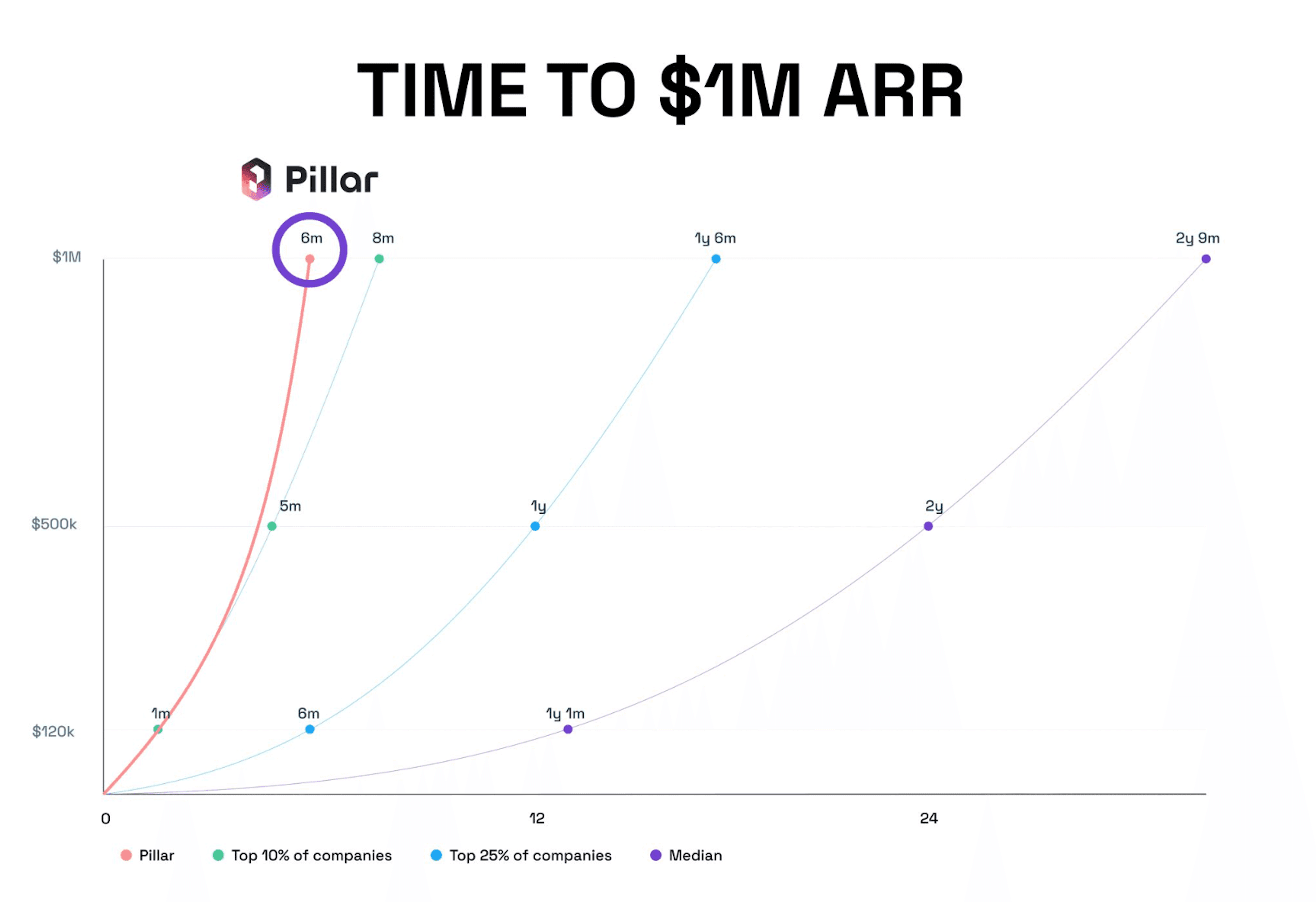
Pillar’s commercial traction reflects that. The company has reached roughly €1M ARR within six months of launch, a pace that speaks both to the acuteness of the pain and to the AI native product's ability to deliver immediate, visible value without lengthy onboarding or change management.
The third key insight was the team’s execution velocity. Construction is a difficult market to serve. The product has to be simple enough for site teams to use, robust and intuitive enough for finance teams to adopt, and localized enough for real compliance workflows. The Pillar team has moved unusually fast across product, hiring, and commercial execution, while keeping a tight feedback loop with customers.
In markets like this, product taste matters. But speed of learning matters even more. Pillar has shown both.
The Road Ahead
The starting point is clear. Pillar will help construction SMEs turn site activity into real-time financial control.
But the long-term opportunity is broader. Once Pillar owns structured AI-extracted project-level data, the product can expand naturally into adjacent workflows. Cost histories feed models that can improve estimating. Supplier and delivery data can support procurement discipline. Better documentation, generated and verified automatically, can reduce disputes between general contractors and subcontractors. Verified receivables, bank data, and project-level margin history can eventually support financial products such as factoring, early payment, supplier financing, or insurance.
Over time, this position Pillar not just as a software provider, but as the AI native financial infrastructure layer for construction where data, workflows and capital are tightly integrated and eliminate repetitive manual work.
Our General Partner, Paul Klemm, shared: “We’ve backed category-defining platforms across Europe for three decades. Pillar has done in months what most companies take years to prove; they cracked a massive, complex industry and built something essential. This is key infrastructure and not a fintech play. We are excited to back team Pillar out of Italy.”
If successful, Pillar can redefine what an ERP looks like for construction, moving from reactive accounting to proactive, AI driven control systems.
We are very excited to back Gabriel, Paolo, Lorenzo, and the entire Pillar team alongside Base10, Emblem and Italian Founders Fund
Welcome to Earlybird, team Pillar.
Read more coverage here: la Repubblica, Tech EU, StartupItalia, Huffpost.
PERSPECTIVES
Related articles
Keep up with Earlybird and our portfolio companies.


