
Back to perspectives
PERSPECTIVES
When more AI means worse AI
A Perspective from Luke Miller, Co-Founder of SLNG, on the pattern that explains why the AI industry is quietly burning money withouth even noticing.
Jul 16, 2026
7 Min Read
Ecosystem Insights

Share
Somewhere out there is a company that spent five hundred million dollars on AI tokens and didn't notice until someone counted.
A number far from any rounding error someone could’ve waved through. Half a billion USD on model calls nobody had intentionally made.
Luke Miller spent twenty years building the systems that made spending like that easy. He helped wire the registries and deployment rails that let a developer ship in an afternoon what used to take a quarter. Now he’s building a company on the idea that the industry he helped shape has picked up an expensive habit it can’t see.
The dependence is impossible to miss in voice, where a single call to an AI agent can fire up three other models for every sentence, in real time.
Since these costs aren't explicitly itemized, they remain rather invisible. And businesses simply see their profit margins shrink, especially those that rely on AI to drive profitability
A year in Ulaanbaatar, Mongolia.
Long before he was preaching for the AI industry to spend less, Miller had been working two decades on the complete opposite side of the problem. He studied computer science at Sydney and started as an engineer, writing code and building web apps for litigation work.
It didn't hold him for long.
He kept reaching for the commercial edge of every company he joined, the place where what technology can do meets what people will actually pay for. But it took a detour to an uncommon location to show him what he was actually looking for.

In 2006, he spent a year in Ulaanbaatar, running an NGO under the World Bank, building low-cost tech centres so people across Mongolia, in the capital and far out in the country, could get online for the first time.
The technology was there for the most part. What was hard was reach: getting a working thing to people the system had skipped, on budgets that rounded to zero.
It was in that year that the question surfaced, the one he'd carry through everything after:
"What can a system really do for the people who can't afford the expensive version of it?"
And ever since, he’s been solving versions of that fundamental problem.
Into APIs before MCPs even existed.
He didn't set out to spend the next decade in developer infrastructure. Looking back, he essentially found his way there. The main thread were APIs, and he was onto them early.
In 2009, when serving data through an API was still mostly the preserve of the big platforms, he built Offset Options, putting environmental data behind one so any developer could pull it straight into a product without building the hard part themselves. That became the shape of everything after.
Take something difficult and wrap it so someone else can just call it, and you've handed them a capability they'd never have built alone.
It was the same instinct as the tech centers in Ulaanbaatar, pointed at developers instead of first-time users.
Over the next decade, Luke rose through the API economy while it was still being built. At 3scale, he brought order to the early chaos of API management and stayed through the company's acquisition by Red Hat.
At HitchHQ, which he co-founded, he used machine learning to generate API documentation before developer tooling had become a thing of its own. GetApp, Typeform, and a leadership stint at npm that ran through its acquisition by GitHub each put him a seat closer to the center of how modern software got assembled.
Before SLNG, Luke was the first VP of Sales at Vercel, a role that provided a unique vantage point on the evolving software landscape. From there, he observed a significant shift:
The infrastructure previously designed for web delivery pivoted rapidly toward AI, fundamentally realigning the entire industry. And suddenly, the API, long the cornerstone of modern software architecture, ceased to be the central focus of the tech stack.
The patterns started to arise
By late 2024, as a Venture Partner at Earlybird, Luke started observing the AI ecosystem across multiple companies. There, he recognized a pattern from before the API era: whenever developers faced a challenge, the default reaction was to automatically reach for the largest, most powerful model.
This behaviour was far from a novelty to him. But this time, the scale did seem different, and the habit was disguised as intelligence rather than waste. At some point, the signs were impossible to ignore. In August 2025, he co-founded SLNG with Ismael Ordaz; a perfect co-founder fit. One takes care of adoption across markets, the other builds the infra.

Tokenmaxxing
The pattern is now widely recognized as "tokenmaxxing". The logic underneath is seductive, but rarely examined: more compute tends to buy better outcomes, so spending more always seems like the safe call. More tokens. More inference. The biggest model for anything that looks hard.
But nobody designed this logic. It took hold because nobody was watching the meter. For the most part in modern AI stacks, unit economics are buried so deep that the cost of a decision is invisible at the moment the decision gets made.
In voice AI, costs hide even further, inside layered model calls, and businesses rarely see the true receipt until their margins have already vanished.
Consider a live agent handling ten thousand calls a day. Every sentence triggers a cascade of parallel models. Without a granular dashboard, that complexity would never register as a line item and in the end it’ll show up instead as a mysterious, steady decline in profitability.
Invisible costs have inverted incentives. A vendor has no reason to economize on what its customers can't see, so the industry began selling compute to itself, dressed up as smarter interactions. But users never asked for tokens. They wanted a booking confirmed, a debt collected, a call resolved. Compute was always the means, never the end.
The best model ≠ the best model for any task
Oftentimes a cheaper AI model will give the exactly the same outcome as the latest one. Sometimes no model is needed at all. The point is, not every spoken sentence needs a GPU.
The whole industry seems to run on the opposite reflex: send every sentence to the smartest model on hand, every time, and let the bill surface later. Its exactly the reflex and habit that cost one company half a billion dollars before anyone thought to count.
SLNG is built to stop that. On every request, it asks the one question the rest of the stack skips:
is the expensive model even the right one here?
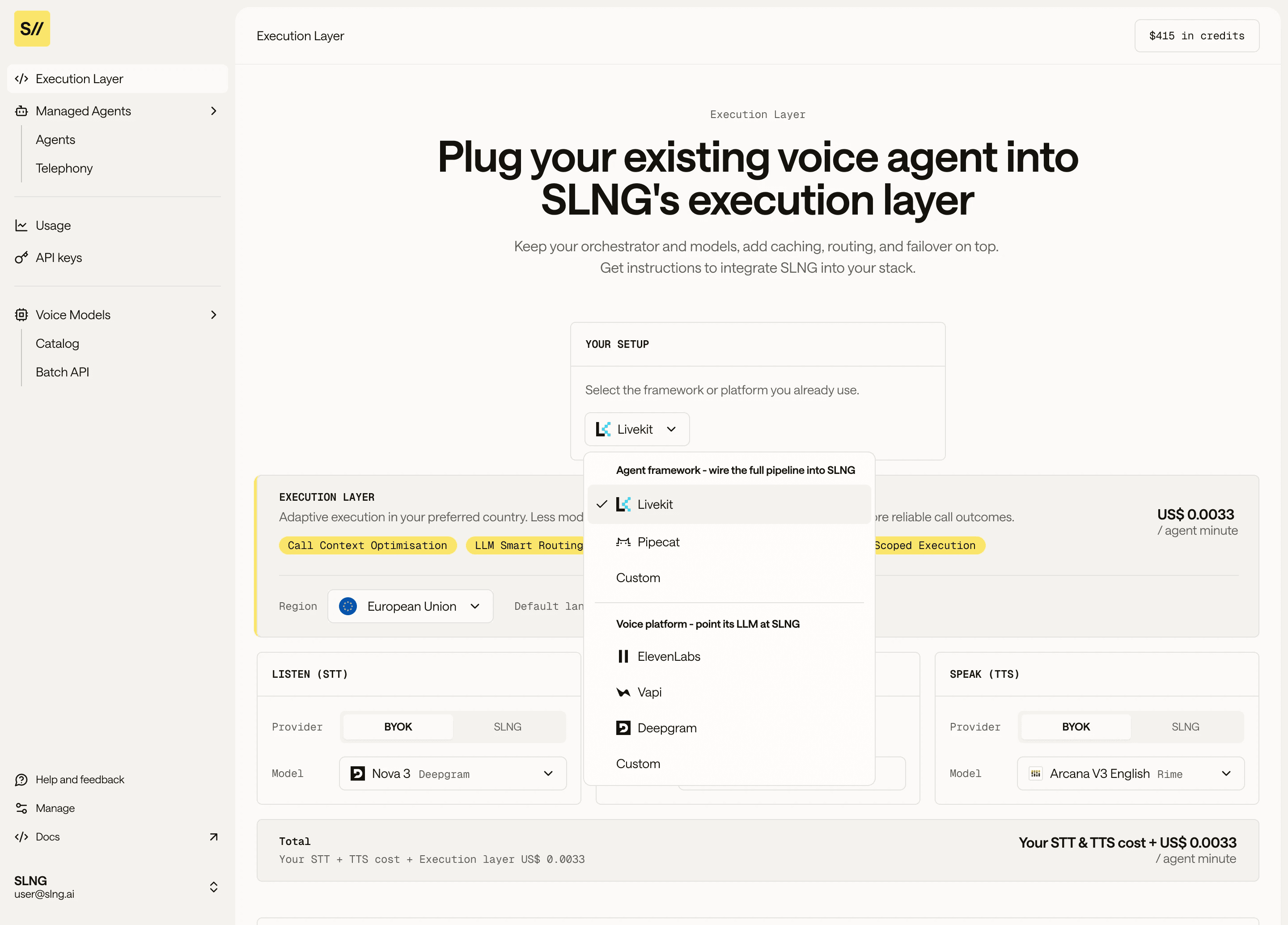
For customers to get that answer, nothing has to be torn down. SLNG sits between the orchestration and the models, so the contracts, the keys, and the providers all stay put, whether that's LiveKit or Pipecat on one side, Deepgram and ElevenLabs on the other. A few endpoints repoint, and the decision in the middle changes. On systems running SLNG, model cost drops by 53%, latency by 39%.
Endless compute is a local assumption
The money is only the visible layer. Underneath sits a question with higher stakes: where AI is allowed to run at all. Cheap, endless compute is a local assumption. It holds across a few square miles of California and fails almost everywhere else. Companies putting AI into production in the rest of the world have a longer list of problems to solve before a single call connects.
Budgets with consequences. Latency that has to clear while a human is still on the line. A dozen languages in one market. And data that legally can't leave the country where it was spoken.
That's most of the world's economy, and almost nothing has been built for it. It turns out that running AI cheaply and running it inside those legal walls are the same engineering problem. So an argument that starts with a wasted half-billion dollars ends somewhere bigger: who gets to use this technology, and on whose terms.
It's the same question Miller first ran into in Ulaanbaatar in 2006, long before any of this had a name. The tools are unrecognisable now. But the problem is fundamentally the same: delivering something that works for the people the system skips, at a price they can pay, under the rules they actually live by.
PERSPECTIVES
Related articles
Keep up with Earlybird and our portfolio companies.


