
Back to perspectives
PERSPECTIVES
When Software Production Outgrows Its Infrastructure
AI is increasing the speed and volume of code production, but the infrastructure that tests and ships it is struggling to keep pace. Through early production deployments with teams including Luo, Sono and GitHits, Avrea is showing how faster, more intelligent CI/CD can remove a growing constraint in the development loop, and why this layer of the stack is becoming increasingly important.
Aug 25, 2026
8 Min Read
Portfolio News

Share
AI has changed how quickly software can be produced. The infrastructure that tests, validates, and ships it still reflects a slower development model. Avrea is rebuilding that layer for a world in which humans and agents iterate together.
For most of software history, producing code was the scarce part of the development process. Engineers wrote changes in relatively discrete batches, then handed them to systems that built, tested, and prepared them for release. That balance is changing with AI coding tools: humans and agents can now generate, revise and submit code continuously, but every proposed change still passes through CI infrastructure designed for a much lower volume of human-generated commits.
When we backed Avrea, we believed this mismatch would expose an under-resourced part of the developer stack. Avrea’s first months with production customers suggest that CI pressure is appearing earlier, and across more teams, than our original thesis assumed. Companies that had little reason to question their CI infrastructure two years ago are now seeing it shape how quickly their engineers can work.
The strategic importance of CI is now extending beyond pipeline speed. Software development is becoming a higher-frequency feedback system, while the infrastructure at its center still reflects the assumptions of a slower, human-led development model.
CI latency is now inside the iteration loop
Most teams begin with the CI infrastructure bundled into their Git provider because it is integrated, familiar, and initially good enough. The trade-offs, however, become more consequential as workload intensity rises.
Shared runners combine several sources of latency. Builds execute on general-purpose virtual CPUs, dependency-heavy jobs are constrained by disk throughput, and caches must be transferred over the network before they can save any work. In monorepos (repositories containing multiple projects) and larger test suites, a cache hit may still require moving substantial amounts of data before execution begins. Queueing adds another variable: the same job can complete quickly at one moment and wait for capacity at another.
Avrea’s own benchmarking shows a material difference between shared cloud environments and dedicated runners across both compute and storage performance. Those differences may be negligible for a team running a handful of builds per day. Across many branches, repeated agent iterations and thousands of weekly commits though, they accumulate inside the core development loop.
The commercial model often compounds the architectural one. When CI is priced by execution time, slower jobs produce higher bills. As teams push more commits, branches and automated fixes through the same infrastructure, they can end up paying more for the latency that is slowing them down.
In an agentic workflow, CI latency sits directly inside the iteration loop. An agent can produce the next fix immediately, but it cannot act on information the pipeline has not returned. An eight-minute run therefore delays every dependent attempt that follows.
At low commit volumes, pipeline latency is friction. At machine-generated commit volumes, it becomes a throughput ceiling.
From pass/fail to actionable feedback
Traditional CI is built to return a status and a log. When a job fails, the engineer still has to determine whether the cause is the current diff, a flaky test, an environmental issue, or an unrelated dependency. That diagnostic work can take longer than producing the next code change.
Agents make this limitation more visible. They can propose fixes quickly, but only when the feedback is timely and structured enough to act on. A failed job with thousands of lines of logs is technically an answer, but often still leaves the developer or agent to determine what actually went wrong and what to do next.
Avrea today combines high-performance CI/CD runners with co-located caching, job-level visibility into build behaviour and a layer of AI quality features on top. Failing tests can be classified and fixed, slow jobs and cache misses surfaced together with a proposed change, and dependency upgrades tested against the real build before they land. The common thread is straightforward: shorten the distance between a failed run and a useful next action.
The direction from there is a broader software delivery platform. Workflow orchestration, job scheduling and deeper quality features can draw on the full context of a run, including the code diff, dependency graph, test history and prior failure signatures. That context can help explain why a run failed, identify the appropriate next action and surface further opportunities to improve the build.
As more of the development loop becomes autonomous, that context becomes increasingly valuable. CI sits at the point where generated code meets the constraints of the real system, giving it a natural role in determining how changes are tested, understood and safely moved forward.
What early production workloads show
Avrea’s earliest production customers are teams for whom CI sits directly inside the development loop. Their products and architectures differ, but the constraint is similar: when every change must be built and tested before the next decision can be made, feedback speed shapes how quickly the team can move.
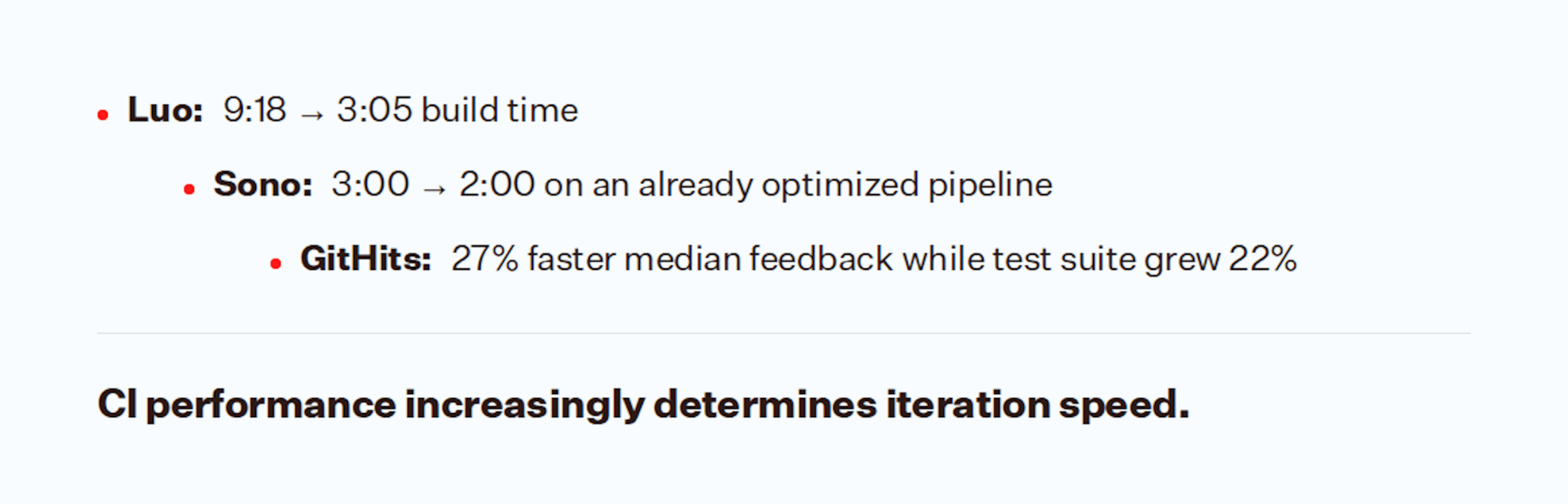
Luo is an AI workspace that turns natural-language tasks into working systems across the tools a company already uses. Its build stage on GitHub Actions took 9 minutes and 18 seconds. After changing a single line in the workflow file to run the same job on Avrea, that time fell to 3 minutes and 5 seconds. The team did not need to redesign the pipeline, migrate to a new CI model, nor spend days tuning the workflow before seeing the difference. “Instead of spending days tuning CI by ourselves, we just turned on Avrea and got an immediate improvement in run times,” said Jaakko Lukkari, Luo’s CTO. For an infrastructure product, that is a meaningful adoption advantage: Avrea can prove its value inside the customer’s existing production workflow, before the team takes on the cost and risk of a broader migration.
Sono came from a different starting point. The company builds AI voice assistants for service businesses, with end-to-end tests that simulate live call scenarios. Its engineering team had already parallelised the pipeline and configured multi-core execution, so the obvious workflow-level improvements had largely been made. Even so, a build that took three minutes with the previous provider ran in two minutes on Avrea before repository-specific caching had been configured. The migration itself took 15 minutes across two pull requests. “Waiting on CI drives me crazy, so our pipeline was already optimized. Avrea was still clearly faster,” said Elias Nygrén, Sono’s co-founder and CTO. The result is important because it shows where the remaining performance gain came from: not another round of application-level tuning, but the execution environment underneath the pipeline.
GitHits presents a third pattern. The company gives AI coding agents access to open-source code and packages, and its own engineering process reflects the same model: humans and agents both contribute changes, and nothing is merged without a successful CI run. In that setup, pipeline latency affects more than developer convenience. It determines how quickly the team can evaluate a change, decide whether to merge it, and move to the next iteration. After switching runner providers, median test feedback became 27% faster even as the test suite expanded by 22%. GitHits therefore shortened the feedback loop while increasing the amount of validation performed on each change. For teams facing rising commit volumes and broader test coverage, infrastructure quality is measured by whether performance holds as the workload grows
These examples show where Avrea is beginning to earn its place in the stack:
Luo demonstrates that teams can test the product without rebuilding their CI setup.
Sono shows that better infrastructure can still create material gains after the workflow itself has already been optimized.
GitHits shows that those gains can hold as the validation workload grows.
None of the three cases requires a grand claim about the future of software development. Avrea is already reducing waiting, removing infrastructure work, and helping engineering teams preserve the speed of their feedback loops as those loops become more demanding.
Earning a place in the stack
Infrastructure products often ask customers to absorb migration risk before the value becomes visible. Avrea enters the stack differently. For teams using GitHub Actions, adoption can begin by changing the runs-on label while preserving the existing workflow, secrets and pipeline logic. Teams can evaluate Avrea against a real production workload without introducing a new pipeline language or rebuilding their development process around a parallel system.
That creates a strong initial proposition: a concrete performance problem, a measurable result, and limited operational disruption. Avrea can earn trust through the execution layer before asking the customer to adopt a broader product.
Infrastructure for autonomous software delivery
AI-generated code is only the most visible part of the change underway. The deeper shift is that more of the path from an idea to a production-ready change can be handled by software systems themselves. An agent can propose an implementation, submit it to CI, interpret the result and revise the code. The effectiveness of that loop depends on the infrastructure responsible for validating each attempt.
Traditional CI was designed to execute jobs and return a status. Agentic development requires a richer control layer: one that can understand the relationship between a code change and a failure, distinguish regressions from flaky tests or infrastructure issues, and determine the appropriate next action. The quality of that feedback will increasingly shape how safely and autonomously software can be produced.
This is the larger opportunity Avrea is pursuing: by sitting between code generation and production, CI/CD can evolve from a passive checkpoint into the system that coordinates how humans and agents test, understand and advance changes. The category is still early, but the direction is increasingly clear: as code production becomes more autonomous, the infrastructure governing what moves forward will need to become more intelligent, contextual and dependable.
Speed matters because iteration matters
AI is increasing both the speed and the volume of code production. The value of that acceleration will depend on the systems that can validate changes, explain failures, and move reliable software toward production without slowing the development loop.
Avrea enters through a problem teams already feel today: execution speed and the quality of CI feedback. Its larger opportunity is to become the layer that helps determine which changes are ready to move forward, whether they were written by engineers or generated by agents.
When we invested, we believed the infrastructure surrounding code generation would become increasingly important, and Avrea’s early customer results strengthen that view. As software development becomes faster and more autonomous, the systems that decide what can ship will become a critical part of the developer stack.
That is the position Avrea is building toward, and we are proud to have been all in from day one.
PERSPECTIVES
Related articles
Keep up with Earlybird and our portfolio companies.